Friday, November 21, 2014

Igloos!


Although igloos are not a really part of the Native life that we have discussed in class, they are a traditional form of temporary housing for the Inuit people of northern Canada.

Also, igloos seem to be the main identifier of northern Inuit people by others.

Igloo or iglu, is a shelter made of packed snow. There are various different configurations of these structures but common features include a dome shape as well as a tunnel leading from the entrance to the interior.

The snow that forms the shelter has exceptional insulation abilities, this is due to the air pockets trapped within the packed snow. Also, when the interior is lined with animal hide and accompanied with a seal oil stove or other heat source, the temperature within the structure is warm enough to prevent freezing to death!

These shelters can be either temporary shelters for hunting expeditions or more advanced structures for a more long term residence.

Here are some examples:

 An illustration of the construction method

 The igloos of a hunting party built on the sea ice

 Engraving from the late 1500s of a Inuit camp on Baffin Island, Canada

 The interior, note the many furs/hides


Saturday, November 8, 2014

Veterans' Day

Since Veterans' Day is this week I am presenting a sculpture that was created to honor Vietnam veterans of Native American Heritage. This statue was created because the monuments in Washington D.C. only depicted white, black, and hispanic soldiers; Native people were not represented.


This bronze statue was created by Harry Whitehorse.
Here is the link to his website, he does work in several different mediums
 http://www.harrywhitehorse.com/viewer-slideshow.htm?37


This statue and many others are located at The Highground in Neillsville, WI. The Highground was created to honor military veterans.

Here are some other monuments located there.

Fragments: Wisconsin Vietnam Veteran Memorial


Earthen Dove Effigy Mound - POW/ MIA


The Nurse - Honoring female veterans


WWII Globe - WWII Service members

Tuesday, October 28, 2014

Native American Song in Translation

Today I would like to look at Native American song. This topic gained my interest due to the video about the button blankets that we viewed in class. Here is a video of a song with the English translation.

Cherokee Morning Song (with translation)
Performed by: Walela


Walela is a Native American trio of singers. The group was founded in 1996 by sisters Rita Coolidge and Priscilla Coolidge, with Priscilla's daughter Laura Satterfield as the third member.

- I believe that it is educational to understand the meanings of the songs. It is much more meaningful to understand that there is a story or message instead of a strange string of sounds. 

Sunday, October 19, 2014

Modern Ledger Art: No Longer a Man's Domain

Ledger art, with its roots in animal hide painting, was traditionally done by men who used the medium to illustrate their hunting and battle stories. But things have changed, as the lifestyle of Native American's has changed, women have been able to enter into this art form.

With the onset of the reservation era, men no longer displayed war and hunting in their art because this was no longer part of their lifestyle. During this era and on, men created illustrations of things such as traditional activities, ceremonies, and reservation life.

The movement away from illustrating the activities of men to a more general set of images was what probably allowed for the entry of women into the field; the life experiences of men and women were no longer so different.

Here is a piece done by a Native American women.


Caddo Women by Dolores Purdy Corcoran, 2007
Caddo Women Taking Repatriation of Ghost Dance Pole Into Their Own Hands

 This is a modern piece done using traditional techniques. It was crafted by Dolores Purdy Corcoran a Caddo woman. The image depicts Caddo women stealing back their ghost dance pole. The image represents the struggle that Native Americans have in retrieving their band's artifacts from the government and other agencies that hold their items.  

Monday, October 13, 2014

Warriors and Symbols: Then and Now

Warriors and Symbols: Then and Now

Ok, so today I want to look at how Native Americans utilized symbols and depictions of powerful animals and objects on their war regalia.

As we were learning about this, I thought back to my time in the military and the symbols and animals that aircraft squadrons displayed on their aircraft; I believe their use is similar. Although native people used these symbols because they were brought to them in visions or they were believed to hold supernatural powers, military units use them because they are powerful animals and symbols ;their supernatural powers are not so relevant.

The native warriors and modern day pilots both adorn themselves and their mounts with symbols of powerful creatures or symbols before they ride/fly into battle.

Interestingly, Native Americans have the highest rate of military service per capita of any ethnic group. Today there are over 190,000 military veterans of Native American ethnicity.

Some examples and comparisons are:

The Navy's "Ragin' Bulls" aircraft and this warrior's shield depicting a bison. Yes, I know that the bull is a domestic animal and not of the same species as a North American bison but this is still a good comparison haha.

- Details of the shield: Humped-Wolf received a vision of a bull buffalo preparing himself for battle. The green band on its upper left section symbolizes Spring, the time for warfare. The black zig-zag lines drawn over the green band represent the paths of bullets deflected by the shield.


A painting by JD Challenger depicts a warrior with lightning bolts on his horse, face, and shield. The modern equivalent is the Marine Corps' "Thunderbolts" who utilize the lightning bolt symbol on their aircraft.


Saturday, October 4, 2014

Birch Bark Canoes

I am interested in making functional things with my hands and I enjoy kayaking/canoeing so, a birch bark canoe is right up my alley. I have always wanted to make one of these!


A basic birch canoe is beautiful but when some artistic styling and art is applied to the hull, it really pops.

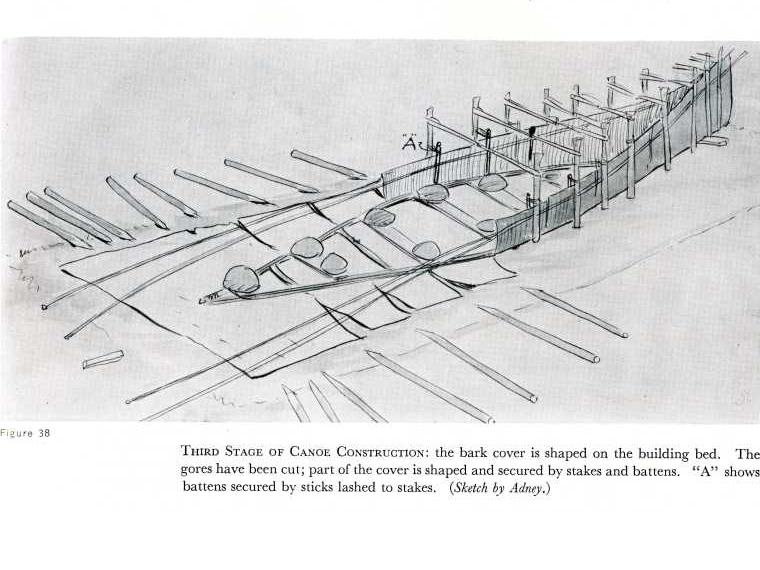
The construction of the canoe is quite interesting. The main hull of the craft is traditionally made from one sheet of birch bark. The bark is saturated with water and bent around a frame to create the initial shape.

Here the bark is removed from the tree. It appears that this tree has already been felled but bark can also be taken from standing trees; careful removal of the bark will not damage the tree.

Also a video of harvesting the bark can be found here: http://youtu.be/FEVEXC5xQAA

Here is a drawing of the frame, held down by rocks, that is used to shape the bark.

Here is a video showing the main steps in the construction: http://youtu.be/6qTDNjhv84U


Thursday, September 25, 2014

Northeastern Native American Art

I will be focusing on Native American art from the Northeast.

I am especially interested in the northern Michigan region due to the fact that I have family ties in this area. Although I do not have any Native American ancestry, I am interested in the native culture and art that my ancestors experienced while living in this area since, at least, the late 1800s.

Original tribes in this area include; Potawatomi, Ojibwe, Odawa, and Menominee.

- One band of Native Americans that many tourists who have visited this area have experienced are The Little Traverse Bay Bands of Odawa Indians (LTBB).

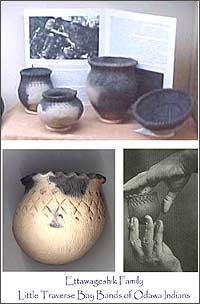
The pots below were made by Frank and Joseph Ettawageshik; members of LTBB. Frank is political leader and the executive director of the United Tribes of Michigan.

The smoking on these pots appears to be similar to the technique used by the artist in the video we viewed in class.


Traditional PotEttawageshik Family